Richtmyer-Meshkov Experiments Utilizing Pistons to Generate the Initial Condition
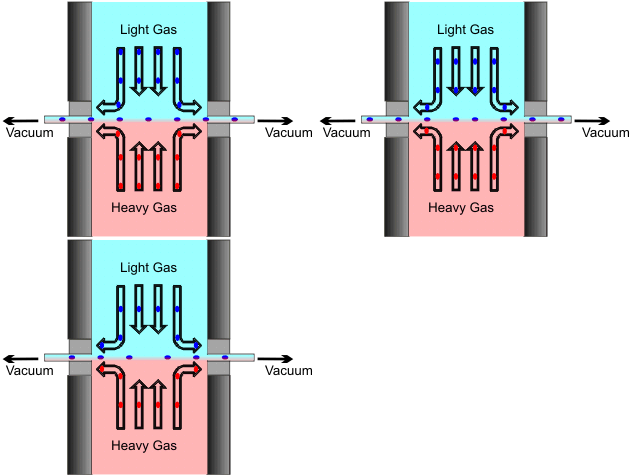
The vertical orientation of the WiSTL shock tube allows for the creation of an interface at a stagnation plane. As shown in the sketch on the right, a light gas (blue) is introduced at the top of the driven section, just below the diaphragm, and flows downward into the test section. A heavy gas (red) is introduced at the bottom of the shock tube and flows upward into the test section. When the flowrates of the light and heavy gases are properly balanced a stagnation plane becomes the interface between the two gases. The gas mixture at the stagnation plane is withdrawn through slots connected to a plenum which is kept at slight vacuum. This technique requires Rayleigh-Taylor stability which means it is not possible to create an interface in this manner with a heavy gas above a light one. Thus, in the WiSTL shock tube, the shock acceleration is from the light gas to the heavy, although with an upward firing tube it would be possible to accelerate the heavy gas into the light one.
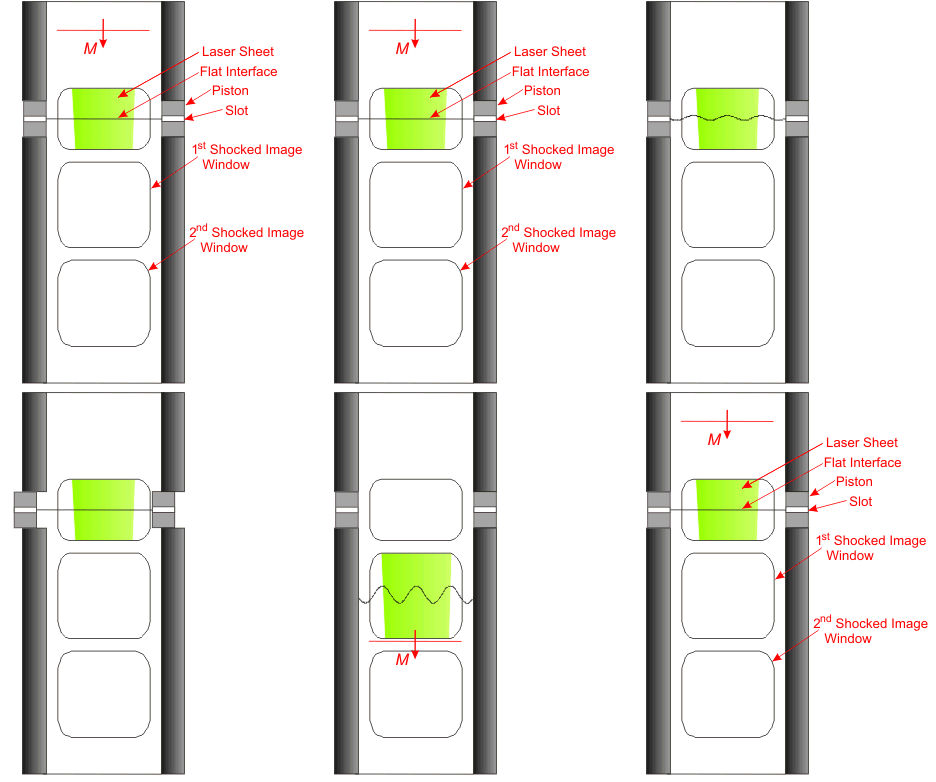
A sketch of the test section on the right shows the key events that occur during an experiment. A two-dimensional slice of the interface at its midplane is illuminated with a laser sheet (shown as green) that enters the shock tube through a window in the bottom flange. When the stagnation plane interface has been properly formed the gas supply valves are closed and the vacuum line for the slots is closed. The slots for evacuating the gas mixture at the stagnation plane reside within rectangular pistons that span the width of the shock tube. The two opposing pistons oscillate synchronously to impose a perturbation on the initially flat interface. After a standing wave has been created on the interface the shock wave is launched. In this sketch of the test section the shock-accelerated interface is visualized twice. The first example of using a stagnation plane as the starting point for an initial condition in a RM experiment was at the University of Arizona (Phys. Fluids 9 (10) p. 3078, 1997) where the perturbation was imposed by oscillating the shock tube.
SDF
ASDFASF
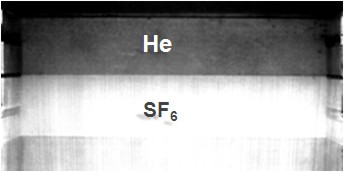
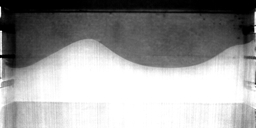
An experimental initial condition generated using this technique is shown below. The light gas is helium (He) and the heavy gas is sulfur-hexafluoride (SF6). This is a low Atwood number interface where the Atwood number is defined as a density ratio A=(rhoH-rhoL)/(rhoH+rhoL) and rhoL is the density of the light gas and rhoH is the density of the heavy gas. The interface is visualized by seeding the SF6 with small (micron-sized) smoke particles while the unseeded He remains transparent. This visualization technique provides a high contrast between the two gases so the geometrical evolution of the interface may be studied. The sinusoidal motion of the pistons generates a standing wave. The high amplitude to wavelength ratio that is created on this interface results in a wave that resembles a curtate cycloid (trochoid) with the highest curvature associated with the peak location of the heavy gas and the lowest curvature with the trough location. From the stagnation plane starting point, the pistons are cycled 3 revolutions at 2.55 Hz and the resulting standing wave is used as the initial condition for the RM experiment. A modal content comparison of the experimental interface with a cosine and cycloid may be seen here.